
Hidden children
A child with a birth record but no school or health contact can be missing from every caseload.
For children
ServiceLine helps organisations see a child's interaction across police, health, school and care contact together, so risk is spotted before it escalates.
A child with a birth record but no school or health contact can be missing from every caseload.
'Was not brought' across two health trusts rarely reaches the same professional.
A move to another council or police area can reset what professionals know.
Police, GP, hospital, school and council systems each hold part of the story, with no shared child reference.
MASH officers phone and email for checks while the clock on a referral runs.
Staff hold back information because they are unsure what they can share, even though the law allows sharing to protect a child.
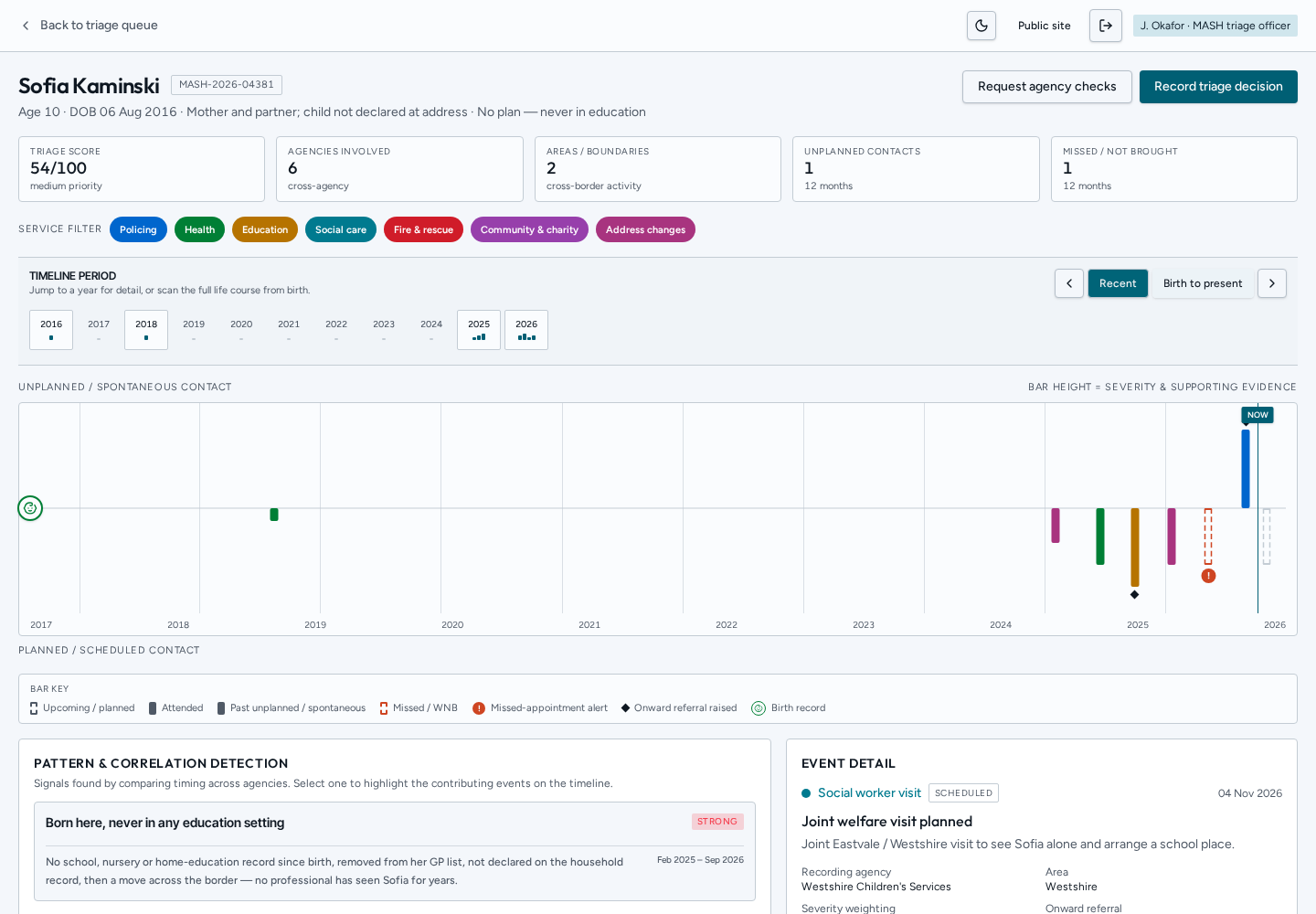
Partner systems share agreed event types through data mapping, not a new case system.
Records are linked to one child, starting from the birth record.
Every contact appears on one timeline, coloured by service and stronger where evidence supports it.
Patterns across agencies and years are surfaced so the right referrals are seen first.
Sofia Kaminski, 10
Born locally, never enrolled in school, then moves across the border.
Molly Hartnett, 2
Missed appointments across two trusts before a 999 call.
Kofi Adeyemi, 15
Stopped by another police force, then persistent school absence.
All names and records in the demo are fictional.
Victoria Climbié (2000)
Many missed chances across several agencies and councils; led to the Children Act 2004.
Peter Connelly, “Baby P” (2007)
Over 60 contacts in eight months, with warning signs spread across services.
Arthur Labinjo-Hughes and Star Hobson (2020)
The national review found weaknesses in information sharing and joint risk judgements.
Short summaries of public reviews. Read the full reports for exact findings.
One timeline that carries on when a young person turns 18.